The Homework: March 20, 2026

Welcome to the March 20, 2026 Main edition of The Homework, the official newsletter of California YIMBY — legislative updates, news clips, housing research and analysis, and the latest writings from the California YIMBY team.
|
We want to make sure this newsletter is as useful to you as possible. Tell us what’s working, what’s not, and more in this 4-5 minute survey. |
News from Sacramento
The legislative session is in full swing at the Capitol, and hearings on California YIMBY sponsored and priority bills should begin soon. The following are tentatively scheduled for a hearing in early April in the Senate Housing Committee:
- SB 1116 (Caballero) will streamline the construction of smaller, lower-cost “starter” homes for home ownership by making several improvements to existing state housing law.
- SB 1117 (Cervantes) will make it less costly to build ADUs by removing an arbitrary financial penalty that many jurisdictions impose on ADUs over 750 square feet.
You can learn more about our full legislative package here.
Looking Ahead: Construction Defect Reform
In addition to AB 1406, which will make it easier for homebuyers to purchase new condominiums, California YIMBY is exploring fundamental reforms that could substantially increase the supply of new condos. One reason California builds very few condos (relative to demand) is that the state’s construction defect laws are structured in a way that strongly disincentivizes their construction. A potential solution is to adopt international best practices that balance strong consumer protections with a meaningful opportunity for developers to correct defects before litigation occurs.
The conversation on construction defect reform is evolving in Sacramento, but California YIMBY is advocating that the legislature address this critical issue.
SB 684 (Caballero, 2023) Groundbreaking – We’re Building Homes
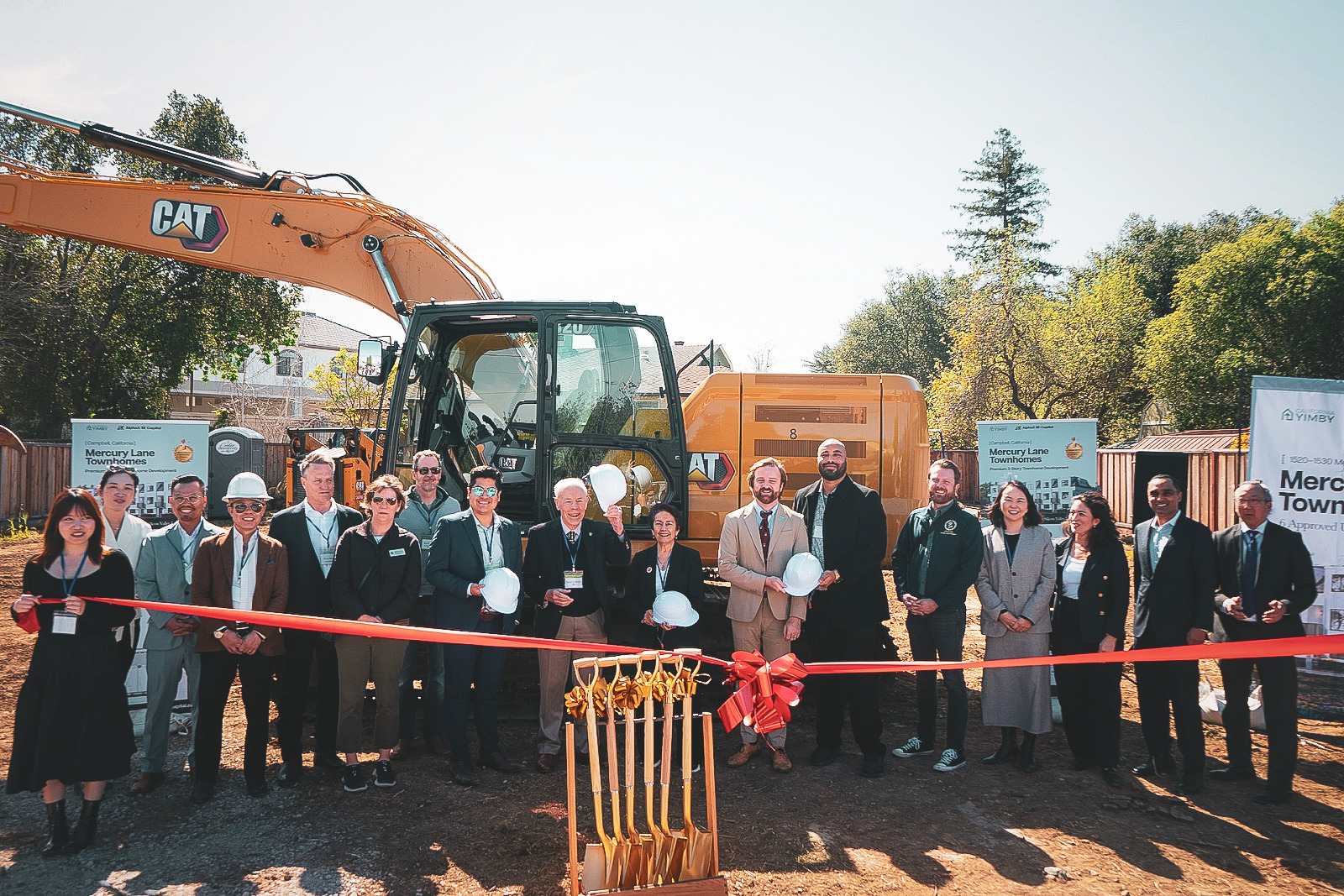
In early March, the California YIMBY team was in Campbell to celebrate a new project by AlphaX RE Capital. What was once a single-family home lot will soon be a home to six new townhomes, each priced at roughly 40% below comparable homes in the area.
Like ADU policy before it, SB 684 and SB 1123 will continue to be refined based on what we’re hearing on the ground, ensuring the law works even better and allows more homes to be built over time.
A huge thank you to Senator Caballero for authoring and championing these bills. This is what courageous housing policy looks like.
Be sure to follow California YIMBY’s Twitter and Bluesky to get more up-to-date news on housing policy, legislation, and research. If you find this newsletter valuable, forward it to a friend!
Housing Research & Analysis
The Most Bipartisan Climate Policy is Housing Policy
The average American spends 170% more time stuck in traffic today than in 1980. A new report argues that the cause is uncoordinated state and local zoning decisions, which have increased car dependence – pushing people toward longer car commutes, and away from transit, walking, and biking.
In Housing Policy That Solves Climate Change: The Policy Platform, Climate Cabinet Education ranks 16 state housing reforms by their political feasibility, potential to reduce driving, and the climate pollution it generates.
Key Takeaways:
- Highest climate impact: Transit-oriented development (TOD) scores a 10 out of 10 for pollution impact. An analysis of Washington’s 2025 TOD law estimates capacity for nearly one million new homes near light rail.
- Highest political accessibility: Eliminating parking minimums is a top-ranked reform the report rates as bipartisan, with data showing it boosts housing construction near transit by 71% on its own.
- Fastest implementation: Accessory dwelling units (ADUs) — secondary homes on existing residential lots — are likely the fastest-moving reform from bill passage to construction, with 14 states preempting local limits on ADUs in some capacity.
Economists Put a Price on Obtaining a Building Permit in LA. It’s Not Small.
If you want to build something in Los Angeles County, waiting for a permit takes time — and now there’s a study estimating the cost of that wait. Researchers find that vacant land with an approved building permit sells for roughly 50% more than comparable unpermitted land, and permitting costs may account for about one-third of the gap between what homes sell for and what they cost to build.
In “How Costly Is Permitting in Housing Development?”, Princeton economist Evan Soltas and MIT economist Jonathan Gruber analyzed a Los Angeles County submarket in which landowners sell properties bundled with fully approved, ready-to-issue building permits, treating the price difference between permitted and unpermitted land as a revealed measure of what developers willingly pay to skip the process.
Key Takeaways:
- A 50% land price premium. Vacant permitted land in Los Angeles County sells for about 50% more than comparable unpermitted land, implying a median permit value of about $48 per square foot of land
- Faster completion. Land sold with permits already approved is 8 to 12 percentage points more likely to be completed within four years of purchase.
- One-third of the cost gap. Permitting is estimated to account for about 32% of the countywide gap between home prices and construction costs, a share that holds roughly steady across neighborhoods.
Houser Headlines
- The Great American Condo Crisis
- Campbell fast-tracks townhome development, first in state
- Building a more beautiful L.A. in an age of ugliness
- California YIMBY adopts new tactics for housing policy change
- This LA mayoral candidate’s climate plan starts with housing
- Local fees trap state housing affordability reforms in a vicious circle
- State law puts more homes near train stops. If LA wants to delay that, it must pick areas to upzone
- Oakland’s Rockridge residents accept that more housing is the new reality
- S.F. leaders propose cutting city’s transfer tax to spur stalled housing projects
YIMBY Social – Top Posts

Share the good word
We welcome your ideas and feedback — send story tips and ideas to Homework@cayimby.org.