On the Race for California Governor: An Abundance of Pro-Housing Candidates
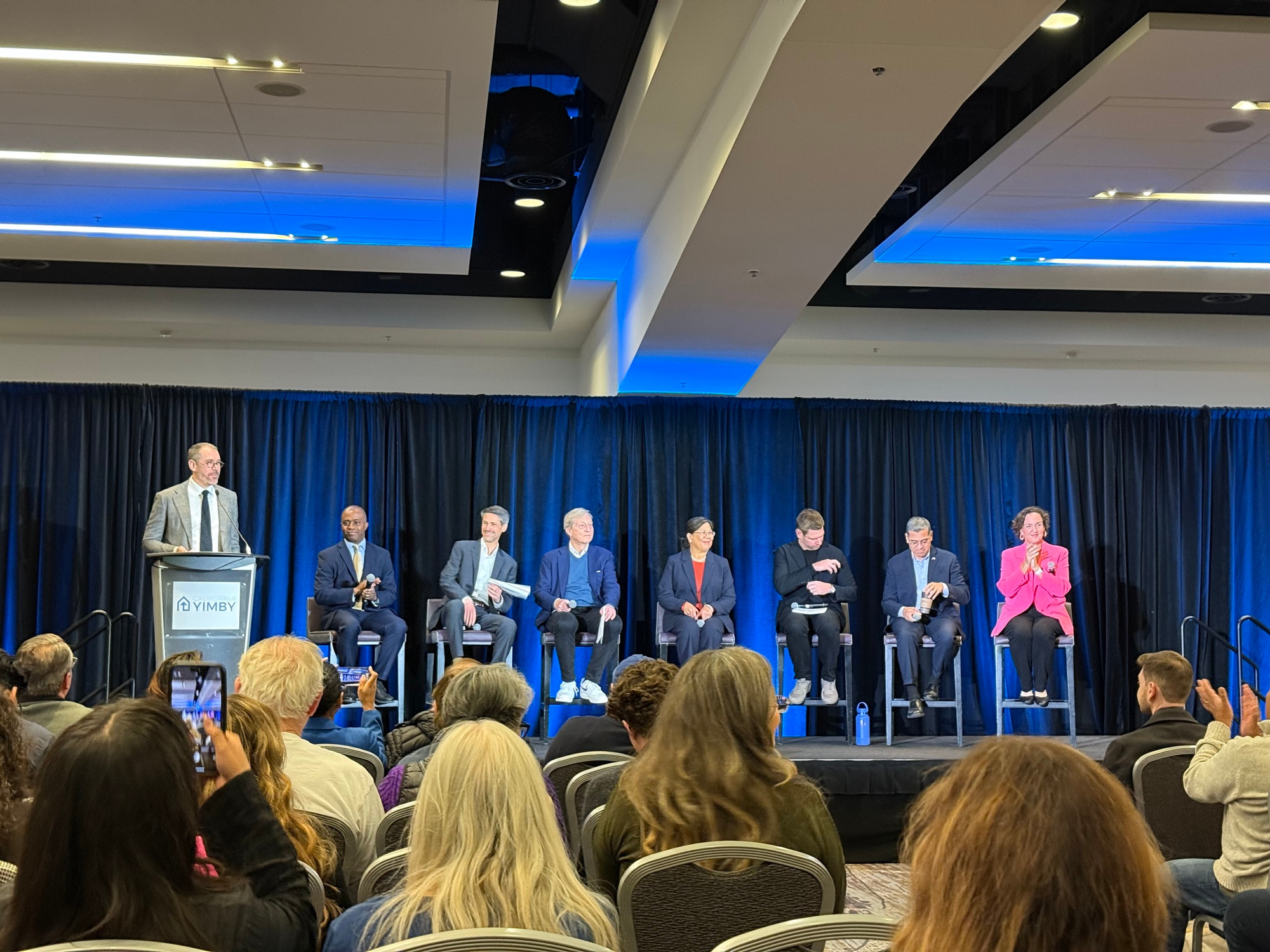
For the past decade, the fight to make it legal and feasible to build housing at scale in California felt Sisyphean. California YIMBY and our allies pushed against exclusionary land use policies, and a political class content to blame the housing crisis on anything but its actual cause: an array of local and state policies that thwarted sufficient homebuilding.
That fight is far from over. We’ve made tremendous legislative progress on upzoning and streamlining housing approvals, and have expanded our “all of the above” approach to include building code reform, condo defect reform, public-private partnerships to build highrises, and allowing starter home presales to unlock ownership opportunities. There is real work ahead, especially to reduce the costs of homebuilding, and we’re not done.
But here’s one notable shift since our founding in 2017: we are winning the political argument. And nowhere is that clearer than in the 2026 gubernatorial primary, where the four leading Democrats are competing with each other to win the YIMBY vote.
Earlier this year, California YIMBY hosted a gubernatorial forum on housing at the State Democratic Party Convention. I emceed. Every leading Democratic candidate showed up, and they didn’t just show up, they competed. They came armed with proposals, some with scribbled notes on their hands, invoked SB 79 as a touchstone, and tried to outflank each other on policies to boost housing supply.
Ten years ago, you couldn’t get a city councilmember to say the word “zoning” in public without flinching. This year, candidates for the most powerful office in California promised how they’d be the most aggressive on local preemption, fee reform, and CEQA. That is an extraordinary shift, and YIMBYs should celebrate it.
This post is our honest assessment of the four leading Democrats: former HHS Secretary Xavier Becerra, businessman and activist Tom Steyer, former Representative Katie Porter, and San Jose Mayor Matt Mahan. We are not endorsing any of them, not because they don’t deserve your vote, but because each candidate can claim solid YIMBY bonafides. Each has put forward credible, substantive pro-housing platforms. Each has real strengths and real weaknesses. YIMBYs should vote for the candidate who best reflects their values and political priorities. Life isn’t just about housing, and a vote for governor is a vote for a person who will set the agenda on dozens of issues beyond ours.
Ballots have already dropped. The primary is June 2. What follows is what we like, what concerns us, and the specific questions we still want answered by each candidate. We’ve tried to be honest and transparent. The candidates deserve that, and so do voters.
Xavier Becerra
What we like:
In 2020, then-Attorney General Becerra did something his predecessors had been unwilling to do: he sued a California city for violating state housing law and won. The City of San Mateo had rejected a modest multifamily development on a site zoned to allow it, citing vague concerns about neighborhood character. Becerra, working with the organization that would become the California Housing Defense Fund (which I co-founded in 2015), took the city to court under the Housing Accountability Act and secured a landmark ruling that established the state’s authority to enforce its own housing laws against recalcitrant local governments. That ruling has since been cited in many subsequent cases. It changed what cities could get away with.
That kind of willingness to take political heat for enforcing the law is exactly what we’ll need from the next governor. Cities will continue to find creative ways to block housing they’re legally required to permit. The next governor needs an attorney general willing to sue them, an HCD willing to penalize them, and the political stomach to back both up when local officials and their legislative delegations come complaining.
Becerra’s gubernatorial platform reflects similar instincts. His proposal to direct state boards and commissions (including the California Coastal Commission!) to prioritize housing production is significant, given how often those bodies slow or block development on procedural grounds. His Housing Master Plan section on reducing construction costs suggests he understands that supply constraints aren’t only about approvals, they’re about feasibility. He supports expanding SB 79 and SB 684 and his call for cities and counties to approve or deny building permits within 90 days is the right kind of concrete, enforceable mandate.
What concerns us:
His proposal to freeze home insurance rates is hard to square with market reality. California is already in an insurance availability crisis driven by climate risk and prior price suppression; further price controls would likely shrink the pool of insurers willing to operate here, which could either freeze new homebuilding (you can’t get a mortgage without insurance) or force the state to assume even more liability through the FAIR Plan. This is a case where the politically appealing answer and the actually-helpful answer point in opposite directions.
Like other candidates, he supports down payment assistance programs. In supply-constrained markets, demand-side subsidies tend to push prices higher rather than expand access. Until we’ve meaningfully increased supply, putting more money in buyers’ hands mostly raises the prices sellers can charge.
Questions we still have:
Becerra came to housing as a campaign priority later than the other top three candidates. He released his full housing plan after ballots dropped. Becerra also tweeted his support for SB 79 after the governor signed it. That’s appreciated, but it’s not the same as showing up during the legislative fight, when the bill was being attacked by powerful interests. Steyer and Porter publicly supported SB 79 when it mattered. While YIMBYs welcome anyone to the pro-housing camp, we want to understand whether his pro-housing positioning reflects a deep commitment or a campaign-season conversion.
Specifically: How far would a Governor Becerra be willing to go on preempting local control to ensure housing gets built? How would he resolve the tension between union labor requirements on housing and the need to lower costs? His answer at last week’s housing forum was vague.
What exactly would his Housing Affordability Master Plan target — labor rules, fee reform, permitting, CEQA reform, building code reform, all of the above? We don’t put much stock in anonymous complaints, but reporting from his time at HHS characterized Becerra as deferential to White House staff and slow to assert authority during crises. Would Gov. Becerra push hard through a difficult legislative process or default to letting others lead? Housing reform requires a governor who will spend political capital, not conserve it.
Tom Steyer
What we like:
Steyer was a vocal, public supporter of SB 79 throughout the legislative fight, not just after the bill was signed. That matters. He showed up to argue the case publicly when it was politically costly to do so, and his willingness to do that tells you something about how he would govern.
He consistently and correctly links housing abundance to economic growth and climate goals. His framing that California cannot meet its environmental targets without building more housing in cities is well-supported by the evidence and resonates with climate-aligned YIMBY voters. He’s engaged with technical policy areas like modernizing the Surplus Lands Act, which suggests a deeper level of policy engagement than surface-level messaging.
His call to build a million new homes in four years is genuinely ambitious. Unlike most ambitious pledges, he paired it with a real revenue plan: ending Proposition 13 protections for industrial and commercial property to raise revenues and reduce cities’ dependence on developer fees that drive up housing costs. This is a serious idea backed by serious analysis, and one that California YIMBY has championed before.
What concerns us:
His support for restrictions on corporate ownership of housing is unlikely to meaningfully improve affordability. Institutional investors own a very small share of California’s housing stock — under 3 percent of single-family homes statewide, concentrated in just a few metros. Policies in this area risk being symbolic rather than effective, and risk feeding a populist politics that misidentifies the actual barriers to abundance: zoning, permitting, fees, and construction costs and productivity.
Questions we still have:
Steyer has paired pro-homebuilding stances with broader economic populism. These two impulses can coexist, but populist politics often focuses on the wrong villains in housing, fixating on corporate landlords or developer concentration when the binding constraints are zoning, permitting, and construction costs. We want to know how Governor Steyer would adjudicate competing demands from interest groups whose stated priorities, like certain forms of inclusionary zoning, anti-demolition rules, or sweeping labor mandates, would make housing more expensive. We hope his successful career in finance would equip Steyer with the knowledge that housing only gets built if it’s profitable to do so. If his ambitious “carrot” proposal to close property a tax loophole fails, would he still compel cities to build housing with a “stick” approach?
We are proud to co-sponsor AB 2074 by Assemblymember Haney with the State Building and Construction Trades Council, because union labor can pencil on high-rise housing when paired with subsidized financing. The bill represents a genuine alignment of interests. But union labor requirements applied to all homebuilding, including the smaller infill projects that could dominate California’s housing future, would be catastrophic for affordability. Many of our best union allies understand this. Some don’t. The next governor needs to know the difference and be willing to say so out loud.
Steyer has put forward many ambitious proposals. We want to know which ones he’d push first, because legislative leadership and gubernatorial attention are scarce, and you can’t accomplish everything on day one. The risk with a candidate who has many priorities is that none of them get the sustained executive focus they need to actually pass.
Katie Porter
What we like:
Porter, like Steyer, was an early and public supporter of SB 79. She showed up during the fight. That counts.
She has demonstrated a rare combination of policy expertise and political courage. She correctly identifies the need for both pre- and post-entitlement reform, including faster utility hookups, which is one of the most overlooked bottlenecks in actually getting homes built. She has also called for changes to the state building code that align with the work we’ve been doing. Porter has been clear that supply constraints are driving up costs for renters and first-time buyers alike.
Critically, Porter has also demonstrated a willingness to take on political allies in labor, and not require “skilled and trained” policy language in every housing bill – language that is well-intentioned, but often leads to higher housing costs or, worse, new housing projects that don’t pencil at all.
That kind of bold truth-telling is exactly what is needed to give Californians confidence that government is focused on solving problems rather than catering to interest groups. The politic move is to gesture at every coalition partner’s priorities and promise everything to everyone. Porter has been willing to say no, which suggests she understands what governing actually requires.
What concerns us:
Like Steyer, Porter has articulated an economic populist platform — raising corporate taxes and eliminating income taxes on those making under $100,000. We worry that such a radical shift in California’s tax structure, which is already heavily dependent on the fortunes of the wealthy, could harm the state’s fiscal position and dampen the investment appetite that homebuilding requires.
Questions we still have:
On tenant protections: how does Porter balance her longstanding and strong support for renters’ rights with the imperative to build vastly more housing, knowing that some tenant protection regimes (overly restrictive rent control, anti-demolition rules) reduce housing supply, thereby increasing market rents?
On the management question that has dominated recent campaign coverage: many of Porter’s former staffers have praised her in writing — the thirty-staffer letter is a real and meaningful counterweight — but other accounts and several viral incidents are cause for concern. Building and passing major housing legislation requires sustained collaboration with the Legislature and the ability to attract and retain top staff. Sacramento is a small town; relationships matter. We want to understand how Porter would manage the interpersonal demands of the office.
Matt Mahan
What we like:
Mahan has the strongest track record of actually unlocking housing of any candidate in this race. As Mayor of San Jose, he correctly diagnosed the problem that has emerged as the binding constraint on California homebuilding — that even when zoning permits a project, the project doesn’t pencil — and he did something about it. He cut development fees, and thousands of new homes broke ground as a direct result. After a year in which San Jose saw zero market-rate housing starts, his fee reform produced 2,000 ground-breakings the following year. That is not a small thing. That is the kind of concrete, measurable impact that California’s housing politics has been starved of.
His statewide platform reflects that same focus. The fifteen-point plan he’s put forward is the most detailed of any candidate in the race. He calls to eliminate barriers to housing finance, speed up ADU construction, align climate and housing policy by making infill development near jobs and transit the default, and rethink the state building code to address out-of-control construction costs. He proposes letting cities keep more of the property tax increment from new housing — a structural reform that would align local fiscal incentives with statewide housing goals and address one of the deepest causes of municipal anti-housing politics. This is exactly the kind of structural thinking that has been missing from California’s housing debate.
Mahan’s focus on the government-imposed costs of homebuilding is especially valuable now. We have made enormous progress on zoning and permit reform over the past decade — not enough, but enormous. The binding constraint is increasingly that even when you can get permission, the project doesn’t pencil. Fees, mandates, building codes, financing constraints, and labor costs have accumulated to the point where new construction is uneconomic in much of the state. This is the next frontier of housing reform, and Mahan understands it better than anyone else in the field.
What concerns us:
Like others, Mahan supports expanded down payment assistance. The same critique applies: in a supply-constrained market, demand-side subsidies push prices higher and undermine the affordability goals they’re meant to serve.
Despite his fee reform success, overall housing production in San Jose remains weak. The 2,000 ground-breakings are real progress, but they’re a fraction of what San Jose needs to produce, and Mahan should be measured against the gap as well as the progress. We want to see him push further on the cost agenda in his own city.
Questions we still have:
The harder question about Mahan’s candidacy is about his commitment to building more homes wherever they’re needed. As a San Jose councilmember, Mahan opposed SB 9, the bill that allowed limited duplex construction on many single-family lots, while expressing support for building more housing near transit. SB 9 itself has produced very little housing, so his opposition to it is not the substantive concern. The concern is what his framing tells us about where he thinks housing should go. The “build near transit, not in single-family neighborhoods” position has been used across California to limit housing reform to a small fraction of residential land, even though single-family-only zoning across most of urban California is itself a central driver of the housing shortage we’re trying to end.
This is the question we want answered: does Mahan’s housing agenda extend to questioning where housing can be built, or only how much it costs to build housing in places it’s already allowed? Both reforms matter. Cost reduction without expanded permission produces denser development in a small area, which helps but doesn’t scale to meet California’s needs. Expanded permission without cost reduction produces zoning that allows projects that don’t get built. The complete pro-housing agenda has to do both.
Mahan has done one half of the agenda better than anyone in the field. We want to know if he’s prepared to do the other half.
The Republican candidates
The same level of pro-housing seriousness is not on offer from the leading Republicans. Steve Hilton’s rhetoric about a “war on single-family homes” is the kind of conspiratorial framing that produced California’s housing crisis in the first place. Chad Bianco has said little on housing other than blaming his political opponents for a homelessness crisis he has badly misdiagnosed. Neither has earned the YIMBY vote.
This is genuinely a missed opportunity for the California Republican Party, because some of the most thoughtful pro-housing legislators in Sacramento are Republicans. And to be clear, nearly all of California YIMBY’s biggest housing reforms required Republican votes to pass. These legislators understand that housing isn’t — or shouldn’t be — a partisan issue.
Where this leaves us
The four leading Democrats are aligned on housing in a way that was unimaginable a decade ago. That alignment didn’t happen by accident. It is the result of years of YIMBY grassroots organizing: activists showing up at planning commission meetings, volunteers knocking doors for pro-housing candidates, and our coalition winning tough legislative battles, including last year’s historic SB 79. (Posting helped too.)
This is a moment to recognize hard-won progress. YIMBY voters are fortunate to have multiple candidates in this race who understand that housing abundance is the only viable path to affordability. None of them is perfect. Each has real strengths and real concerns we’ve tried to articulate honestly. Vote for the one who best reflects your values and political priorities.
A few asks for whoever wins:
Lead. Don’t just preside. Ending California’s housing shortage requires a strong governor to make their priorities clear. The next governor will face enormous pressure from interest groups — labor groups, environmental groups, city governments, tenant advocates, homeowners associations — to compromise the reforms that actually matter in exchange for ones that don’t. The right answer is to lead with the reforms that scale homebuilding, not to dilute them in the name of coalition management. Bills don’t pass themselves. Coalitions don’t hold themselves together. The next governor must spend political capital to deliver, not conserve it.
Refuse “everything bagel” policymaking. It is always tempting in California to load every housing bill with worthwhile goals, like strong labor standards, affordable housing mandates, extra environmental review, public art, community benefits, et al, until the underlying goal of building housing becomes economically infeasible. Like former Gov. Jerry Brown said at the 2017 housing package signing ceremony, “too many goods can create a bad.” Each addition has its own constituency and its own legitimate logic. But the cumulative effect is to make housing impossibly expensive to build, which is the opposite of what we set out to do. The next governor must be willing to tell allies no when the alternative is failing on the underlying mission. A bill that doesn’t produce housing is not pro-housing, no matter its intent.
Appoint committed housing leaders to every administrative post. The Coastal Commission, HCD, the Department of Finance, the State Lands Commission, the various boards and commissions that touch development, these positions matter. Personnel is policy, especially in housing. The next governor’s appointees will determine whether SB 79 is implemented aggressively or watered down through guidance, whether the Coastal Commission becomes a partner or remains an obstacle, whether HCD enforces the housing element law or treats it as advisory. A governor who appoints reformers to every housing-relevant post will accomplish more than one who passes legislation and lets the implementation drift.
California’s next governor will inherit enormous challenges. We need a better plan for rebuilding after climate disasters. We need to keep our economy competitive against states that have learned to build. We need to continue defending the values of our diverse, tolerant, and visionary state. None of this will be possible if California remains unaffordable for a growing share of its residents. None of us should accept a future where our own children can’t afford to live here, or where young families flee to more affordable states.
A decade ago, YIMBYs were fighting just to be heard. Today, candidates for governor are competing to show they share our vision. Take a moment to celebrate the progress.
Then fill out your ballot, and get back to work!